THANK YOU FOR SUBSCRIBING


CFO Tech Outlook Weekly Brief
Be first to read the latest tech news, Industry Leader's Insights, and CIO interviews of medium and large enterprises exclusively from CFO Tech Outlook
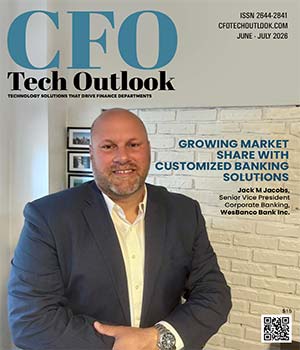
Jack M. Jacobs is the Senior Vice President of Commercial Banking at WesBanco Bank Inc., specializing in developing relationships with Middle Market companies. He focuses on providing tailored banking solutions, including lending, treasury management and fraud protection, to clients both locally in Pittsburgh and nationally. Jack is dedicated to driving growth for the bank while remaining actively involved in his community through volunteerism and local engagements. Strategic Banking Solutions for Middle Market Companies My role with the bank involves a focus on increasing market share by bringing in the relationship of Middle Market companies within our footprint. I work in the Pittsburgh market but also have clients who are headquartered outside of the city. Daily focus includes tailoring solutions which align with their goals in all areas of banking including lending and depository needs. We offer complete lending solutions to our corporate clients including revolving credit lines, permanent working capital, equipment financing, loans to facilitate M&A, commercial real estate, etc. Maximizing Value through Comprehensive Banking Services In addition to commercial lending, we help our clients protect themselves from fraud while maximizing their cash flow with the appropriate treasury management services. Outside of the bank, it is important to stay involved in the community. Volunteer efforts and attending important functions in the city are a way to make a difference in the market. “My role with the bank involves a focus on increasing market share by bringing in the relationship of Middle Market companies within our footprint.” The competition is stronger than ever. For a large share of banks, the growth engine and largest profit center of the organization is the commercial bank. At the same time, companies have become increasingly more educated on the important nuances of their banking relationship. It is not as vanilla as simply looking at loans and de
What challenge do multi-entity organizations face when financial systems vary by location? Franchises, dioceses, accounting firms and other multi-entity organizations operate as networks of independent entities, each maintaining its own accounting system and chart of accounts. As these networks grow, financial data becomes inconsistent across locations, making reliable consolidation and benchmarking difficult. For CFOs and finance teams responsible for multi-entity oversight, fragmented reporting limits financial control and delays informed decision-making. How does Qvinci centralize financial and nonfinancial data across distributed entities securely? Qvinci was developed specifically to resolve that fragmentation within one-to-many accounting and data environments. The platform connects directly to QuickBooks and other accounting and data systems used across distributed entities, securely extracting financial and nonfinancial data from each location into a centralized cloud environment in near real-time. Aggregation alone, however, does not create clarity. The core challenge lies in aligning fundamentally different charts of accounts and data sets without mandating uniform accounting practices. Qvinci addresses this through automated structural mapping, translating disparate financial and data architectures into a standardized corporate reporting model while preserving local independence. “Clarity doesn’t come from more reports. It comes from having the right data structured the right way,” says Brad A. Adams, president, CEO and chairman. “If you have fragmented data, you get garbage data in, garbage analysis out.” Why did standardizing disparate accounting structures require engineering at the data layer? Solving that alignment problem required engineering at the data layer. In 2008, Qvinci invented and patented its automated consolidation framework to standardize financial reporting across different accounting environments. The company now holds nine patents covering the processes that enable this automated mapping at scale..


What initial challenges do foreign entrepreneurs face when establishing businesses in the United States? “As a foreign national living in Florida for 10 years, I’m trying to help other foreign nationals do the same. To move to the U.S. and to invest in the U.S,” states Rodrigo Barbonetti, owner of SF Accounting Services. That perspective shapes how SF Accounting Services operates. The work does not begin with tax filings. It begins with incorporation, because that is where some of the most consequential decisions are made. Many foreign nationals assume forming an LLC is straightforward. In practice, it can generate reporting obligations and liabilities in their home country that are often not explained at the point of setup. Barbonetti’s position here is direct: most clients arrive focused on the finish line without understanding how the structure they chose determines every outcome that follows. They start from the end, focusing on taxes, rather than on how the company is created. That thinking also governs how roles are divided within the firm. In most small practices, the owner handles both advisory and execution. At SF Accounting Services, the two are separated. Barbonetti focuses on guidance and counsel, while other qualified professionals handle processing. Advice is always free. Fees apply only to work that is actually executed, giving clients the space to understand their situation fully before committing to a course of action..
Wishing for Wealth should always be paired with the boon to preserve it—because if the former is granted, the latter becomes a necessity. A windfall of wealth, no matter how large, can easily be squandered if not handled well. With considerations like investment, financial, taxation and estate planning, trusted financial advisors must be roped in as fiduciaries for the newfound wealth. However, the ever-expanding scope of their service demands a more holistic wealth management approach, which is realistically possible through Wealth Inc. A renowned name in the world of fintech, the firm enables financial advisors to provide greater number of services at scale efficiently and economically through its wealth planning platform, Wealth.com. Specializing in estate planning, it empowers financial advisors and entities by modernizing the delivery of estate planning guidance to their clients. Wealth.com is the only tech-led, end-to-end estate planning platform built specifically for financial institutions and advisors. “Our platform uses technology to drive efficiency and repeatability without compromising quality or the bespoke nature of the financial advisory work,” says Danny Lohrfink, co-founder and CPO. Wealth.com stands out from the market in delivering a truly scalable experience for financial advisors. This focus on scalability is ingrained in the platform by its creators, including a CEO with a CTO background. They ensured that unlike traditional point solutions that operate in silos, Wealth.com is designed with integration and scale in mind. This design philosophy eliminates the inefficiencies of fragmented tech stacks—common when managing multiple platforms that don’t communicate with one another. Wealth.com avoids this pitfall by directly embedding an advisor’s existing systems through API integrations. When an advisor logs in for the first time, the dashboard is already populated with their entire business book. Eliminating inefficiencies and giving advisors a comprehensive, real-time view of their clients without lifting a finger. This frictionless onboarding process is a game-changer, positioning Wealth.com as a tech-forward, advisor-first platform built for the modern-day finance professionals. They can use the platform to serve clients across the net worth spectrum. Wealth.com offers a scalable solution that adapts to each client’s unique needs. Whether helping a mass affluent client draft their first will, evaluate the impact of relocation on inheritance and tax liability, or assist an ultra-high net worth client visualize an estate with Spousal Lifetime Access Trusts (SLATs), Grantor Retained Annuity Trusts (GRATs) and Irrevocable Life Insurance Trusts (ILITs).

Douglas Maxwell, Chief Financial Officer, American First Finance

Richard Kung, Chief Financial Officer, CTBC Bank Corp. (USA)

Amanda Van Vooren, Division Credit Manager, Poolcorp

Linda Wilson, Senior Growth Account Executive, Transact Campus Inc

Hiba Yazbeck, Head of Finance and Accounting, MAHLE [BVMF: LEVE3]
Accounting and tax solutions empower CFOs with real-time insights, automation, and compliance tools to drive efficient, strategic financial management and growth.
Financial intelligence advances through automation, analytics, and regulation, enhancing transparency, accuracy, and decision-making while strengthening resilience across global financial systems.
Building Smarter Financial Visibility Across Enterprises
On the cover, Jack M. Jacobs, Senior Vice President of Commercial Banking at WesBanco Bank, shares how customized banking strategies, treasury innovation and relationship-focused commercial banking are helping middle market companies navigate growth, liquidity management and an increasingly competitive financial landscape.
Among the companies driving this transformation is Qvinci, recognized as the Top Intuit Reporting App 2026, which addresses a major challenge in multi-entity finance environments: fragmented financial reporting. Its platform consolidates financial and nonfinancial data from different accounting systems into a standardized reporting structure while preserving local operational independence. By automating data mapping and consolidation, Qvinci enables finance leaders to benchmark performance, evaluate risk exposure and improve decision velocity across large networks. Its patented reporting framework and Qvinci Intelligence capabilities further strengthen financial analysis by linking high-level reporting to transaction-level insight.
SF Accounting Services, named Top Accounting and Tax Solution 2026, has built its practice around helping foreign entrepreneurs navigate the financial and regulatory realities of operating in the U.S. The firm focuses on entity structuring, cross-border tax obligations and compliance planning before problems emerge. Its advisory-led model helps clients avoid costly reporting mistakes while supporting banking relationships, KYC requirements and long-term operational planning across jurisdictions.
This edition also features insights from Christopher DeAngelis, VP, Enterprise Fraud Strategy & Prevention at Zelis, on the rise of dormant healthcare provider fraud and the need for AI-driven fraud detection and digital forensics. Luis Juarez, Vice President of Accounts Payable, Global Shared Services at FirstService Residential, discusses how structured planning, collaboration and disciplined technology adoption are shaping finance transformation initiatives.
We invite you to explore this edition as finance leaders continue to redefine how organizations manage risk, scale operations and build long-term resilience.